

One-Time Payment LMS vs MonthlySubscription: Which Is Better for CoachingInstitutes?
23rd November 2026
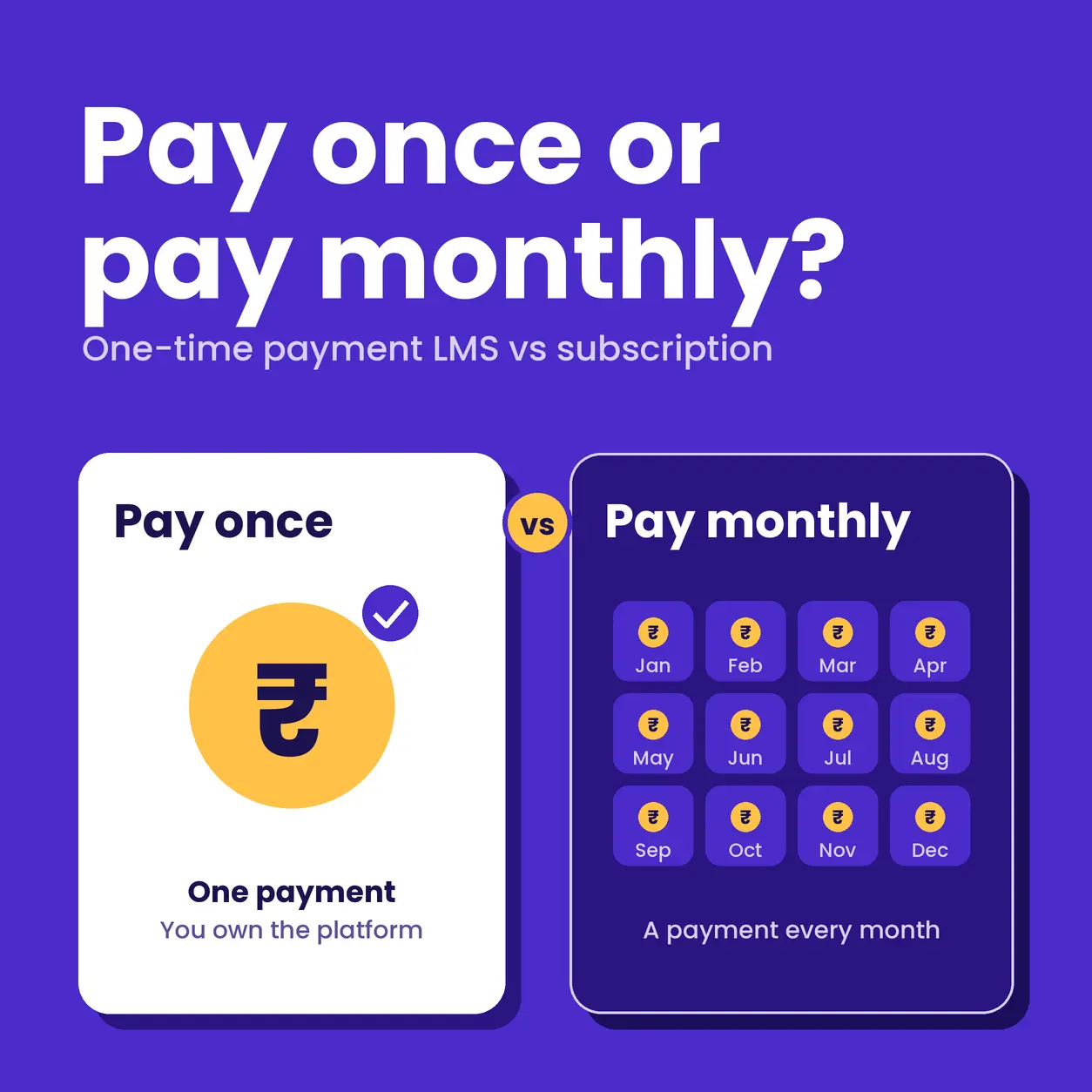
For most coaching institutes, the choice comes down to convenience versus control. A monthly subscription LMS is quicker to start, but the fee never ends and the provider decides your features. A one-time payment LMS, where you buy the source code and host it yourself, needs more effort at the start, but you own the platform, the data and the branding, and you avoid recurring licence fees.
The short answer
- Choose a monthly subscription if you want to start this week, have no technical help,and are happy to pay a recurring fee for a managed service.
- Choose a one-time payment LMS if you plan to run your platform for years, want your own brand, domain and data, and can arrange hosting and basic technical support.
The rest of this guide explains the costs, the trade-offs and the questions to ask before you decide.
What is a monthly subscription LMS?
A subscription LMS is a hosted platform. The provider runs the servers, updates the software and gives you an account. You pay a monthly or yearly fee, and the price usually depends on the plan, the number of students or the features you choose. Classplus,
Teachmint, Graphy and Edmingle are examples of hosted platforms used by coaching institutes in India. Their plans and prices change, so check each provider’s current offer.
What is a one-time payment LMS?
A one-time payment LMS is ready-made software that you buy once. You receive the source code, install it on your own server and customise it for your institute. There is no recurring licence fee, though you still pay for hosting, a domain and any setup or support you need.
Example: Veyond LMS costs ₹4,999 as a one-time payment. It includes student, instructor and admin dashboards, free and paid courses, video lessons, tests and quizzes, Razorpay payments, analytics and RESTAPIs.
How do the costs compare over three years?
Do not compare only the first month. Add up the full cost over three years.
- Subscription total = monthly fee × 36 months, plus any extra charges for add-ons or higher plans.
- One-time LMS total = licence price + server hosting for 36 months + domain + deployment or customisation help + any support you choose.
Here is an illustration. It uses an example figure, not a real quote. Suppose a hosted plan costs ₹5,000 per month. Over 36 months that is ₹1,80,000. A one-time LMS such as Veyond LMS has a ₹4,999 licence, and you add the cost of a server, a domain and any
setup help. Depending on the quotes you get, the one-time route can be much cheaper over several years. Check real prices from the providers you are considering, because plans differ.
Subscription LMS: pros and cons
Pros
- Quick to start, often within days
- The provider handles hosting, updates and uptime
- No technical setup on your side
- Some platforms include a branded mobile app and live-class tools
Cons
- The fee continues for as long as you use the platform
- Features, limits and pricing are decided by the provider
- Your branding and domain options may be limited
- Moving away later can take effort, because your content and student data sit on someone else’s system
One-time payment LMS: pros and cons
Pros
- You pay for the licence once
- You own the source code, so you can customise it
- Your student data and course content sit on your own server
- Full control of your brand, domain and website sections
- You can add features and integrations as you grow
Cons
- Someone must deploy it and keep the server running
- You are responsible for backups and security updates, or you pay for support
- Features such as live classes and attendance tracking are not in Veyond LMS’s standard package, so they would need custom development
- A mobile app is a separate project, although the backend is mobile-app ready
Which should you choose?
A subscription LMS fits you if:
- You want to launch within days
- You have no developer or technical person
- You prefer to treat the platform as a monthly service cost
- You need built-in live classes or a ready mobile app right now
A one-time payment LMS fits you if:
- You plan to run the platform for three years or more
- You want your own brand, domain and student data
- You are happy to customise the platform as your institute grows
- You have, or can hire, help for deployment and maintenance
Many owners start with a subscription to test the idea, then move to their own platform once the numbers justify it.
What technical setup does a one-time LMS need?
Veyond LMS is built with Node.js, Express.js, Prisma ORM and MySQL, with RESTAPIs and JWT authentication. In practice you need:
- A VPS or cloud server
- A domain name
- Someone to install it using the provided documentation and installation guide
- A Razorpay account for online payments in India
If you are not technical, this is not a blocker. Veyondtech offers VPS deployment, UI customisation, third-party integrations, mobile app development and ongoing maintenance and support. You can try the admin, instructor and student demo accounts
on the product page before you buy.
Questions to ask before you buy any LMS
- What is the total cost over three years, including hosting, setup and support?
- Who owns the student data and course content?
- Can I export my data if I leave?
- Can I use my own domain and branding?
- Which payment gateways are supported?
- What happens if prices or plans change?
- What support is included, and what costs extra?
- Can I test it with a demo before paying?
- What are the licence terms for the source code?
Frequently asked questions
1. Is a one-time payment LMS really cheaper than a subscription?
Over several years it
often is, because you avoid the recurring licence fee. You still pay for hosting, a domain
and any setup or support, so compare the full three-year cost.
2. Do I need a developer to run a one-time payment LMS?
Someone needs to deploy it on a server and look after it. If you do not have a developer, Veyondtech can handle
deployment and maintenance.
3. Who owns the student data?
When you host the LMS on your own server, the student data and course content sit on your server, so you control them. Take regular backups.
4. Can I move from a subscription platform to my own LMS later?
Yes, it is possible. Export what your current platform allows, such as course content and student lists, and check its
terms. Run both platforms side by side for a short time while students move over.
5. Does Veyond LMS accept online payments?
Yes. It includes Razorpay payment integration, purchase tracking and revenue reports. Other payment gateways would need
customisation.
6. Can a single tutor use Veyond LMS?
Yes. It supports instructors, tutors and trainers who want to create, publish and sell courses.
7. What do I get after buying Veyond LMS?
You get the complete source code, the student, instructor and admin panels, RESTAPIs, the Razorpay integration, the SEO and community modules, demo data, documentation and an installation guide.
Share


1 Minutes Read

Ready to discuss your project ?
Let's talk