

5 SEO Mistakes That Are Killing Your Website’s Google Rankings
15th December 2025
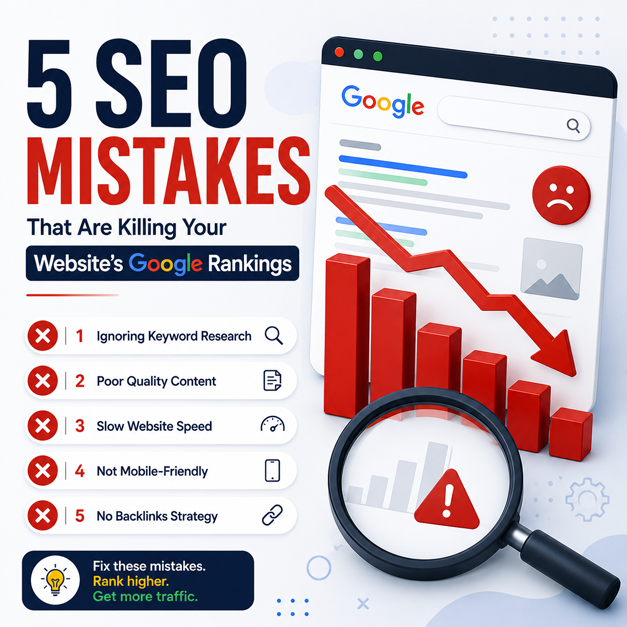
Paint the frustration: You're investing time and money into SEO.
Your competitor's website—which honestly looks worse than yours—ranks #1. Meanwhile, you're nowhere to be found. What gives?
The truth? You're likely making one (or more) of these critical mistakes that Google hates. The good news: they're fixable.
THE 5 HIDDEN SEO KILLERS
Mistake #1: Your Website Speed is a Disaster
The Problem: Your site takes 6+ seconds to load. You don't notice because you're on fast WiFi, but your visitors? They're bouncing before your page even renders.
Why It Matters:
- Google uses page speed as a ranking factor
- 53% of mobile users abandon sites that take over 3 seconds
- Slow sites = poor user experience = lower rankings
The Fix:
- Compress images (use WebP format)
- Enable browser caching
- Minimize CSS and JavaScript
- Use a CDN (Content Delivery Network)
- Test with Google PageSpeed Insights
Quick Win: Run your site through GTmetrix right now. If your load time is over 3 seconds, this is your #1 priority.
Mistake #2: Your Content Has Zero Search Intent Match
The Problem: You're targeting keywords, but you're answering the wrong questions.
Example: Someone searches "best project management software" and your blog post is about "why project management matters." Wrong intent.
Why It Matters: Google's algorithm prioritizes content that matches what users actually want.
Search Intent Types:
- Informational: "How to..." "What is..." "Guide to..."
- Navigational: Brand names, specific sites
- Commercial: "Best..." "Top..." "Review..."
- Transactional: "Buy..." "Price..." "Discount..."
The Fix:
- Google your target keyword
- Analyze top 10 results
- Check content format (listicles, how-tos, product pages)
- Understand what questions are being answered
- Match that format and intent
Mistake #3: Your Mobile Experience is Broken
The Problem: Your desktop site looks great. Your mobile site does not.
Over 60% of searches happen on mobile—and your site is failing them.
Why It Matters: Google uses mobile-first indexing.
Common Mobile Issues:
- Text too small to read
- Clickable elements too close together
- Content wider than screen
- Intrusive pop-ups
- Unplayable content
The Fix:
- Use responsive design
- Test on real devices
- Use Google's Mobile-Friendly Test
- Ensure buttons are tap-friendly (minimum 48px)
- Remove intrusive interstitials
Reality Check: Open your website on your phone right now. Can you easily read and navigate it?
Mistake #4: Your Internal Linking Structure is Non-Existent
The Problem: Every blog post is an island.
Why It Matters:
- Helps Google discover and index pages
- Distributes page authority
- Keeps users engaged
- Establishes topical relevance
The Fix:
- Add 3–5 internal links per post
- Use descriptive anchor text
- Create content clusters
- Link from high-authority pages to new content
- Update old posts regularly
Mistake #5: You're Ignoring Technical SEO Completely
The Problem: You ignore the technical foundation.
Critical Technical Issues:
- Broken pages (404 errors)
- Duplicate content
- Missing meta descriptions
- No XML sitemap
- Not using HTTPS
- Crawl errors
The Fix:
- Use Google Search Console
- Use Screaming Frog
- Fix broken links
- Implement canonical tags
- Create XML sitemap
- Ensure HTTPS
THE COMPOUND EFFECT
These mistakes don’t exist in isolation. Combined, they create a negative impact:
- Poor user experience
- Lack of authority
- Weak structure
One mistake might drop rankings. All five? You're invisible.
HOW TO AUDIT YOUR SITE (Step-by-Step)
Week 1: Speed & Mobile
- Run Google PageSpeed Insights
- Run Mobile-Friendly Test
- Fix critical issues
Week 2: Content & Intent
- List top 10 keywords
- Analyze search results
- Match intent
Week 3: Technical Foundation
- Run Search Console
- Use Screaming Frog
- Fix errors
- Improve internal linking
Week 4: Monitor & Iterate
- Set up Analytics
- Track rankings
- Monitor traffic
- Optimize continuously
REAL RESULTS
Case Study:
- Page load time: 8.2s → 1.9s
- Mobile errors: 47 → 0
- Organic traffic: +156%
- 15 keywords moved to page 1
CONCLUSION
SEO is no longer just about content and keywords. Technical foundation and user experience matter just as much.
Your competitors are likely making these same mistakes. Fix them first—and you'll outrank them.
Get Help
Not sure where to start?
Get a free SEO audit from Veyondtech.
We'll analyze your website, identify issues, and provide a clear action plan.
Share


1 Minutes Read

Ready to discuss your project ?
Let's talk